TMR vs Hall Effect: 2026 Controller Sensor Buying Guide
TMR and Hall effect are both non-contact magnetic sensors used in controller thumbsticks to avoid the physical wear that causes stick drift.
TMR sticks vs hall effect compared: lifespan, accuracy, magnetic interference, cost. Which sensor lasts longest in a PS5, Xbox, or PC controller in 2026?
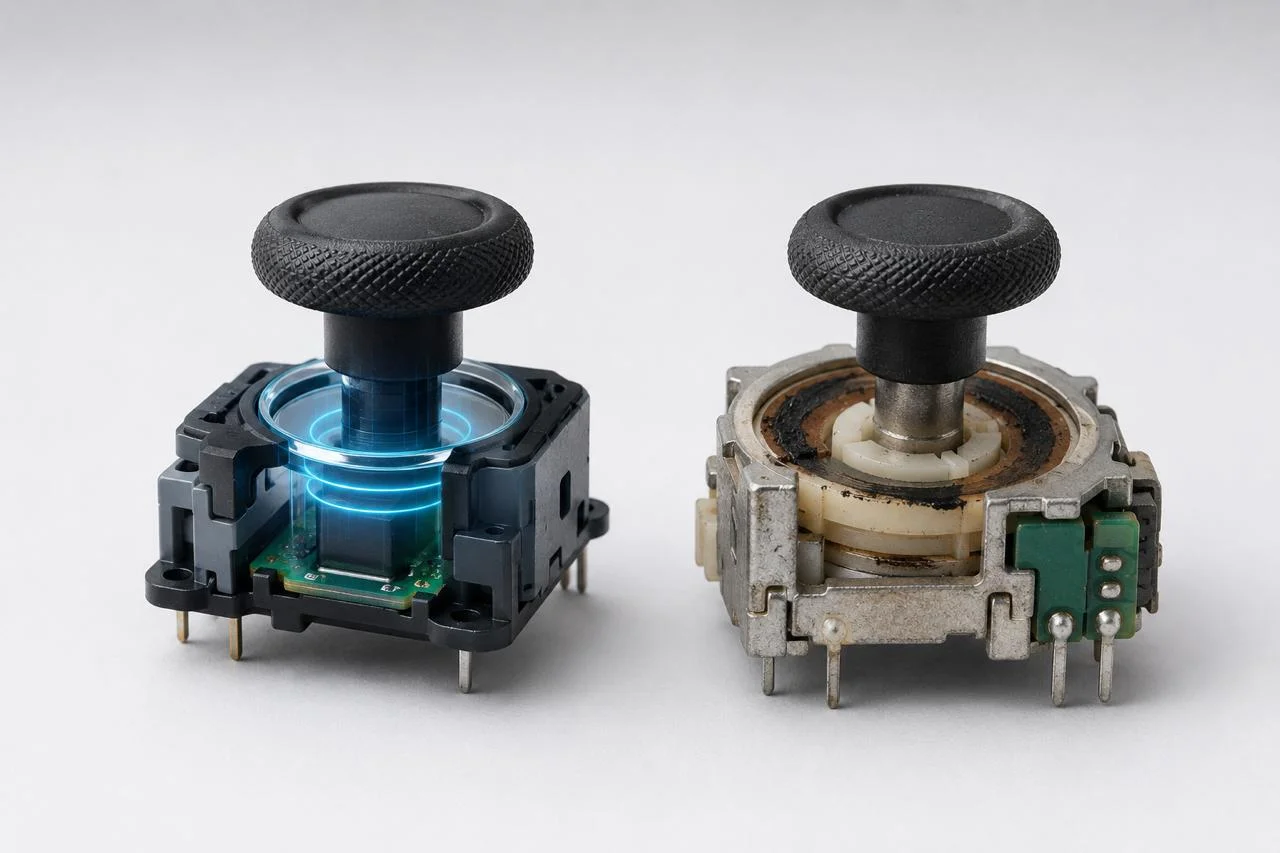
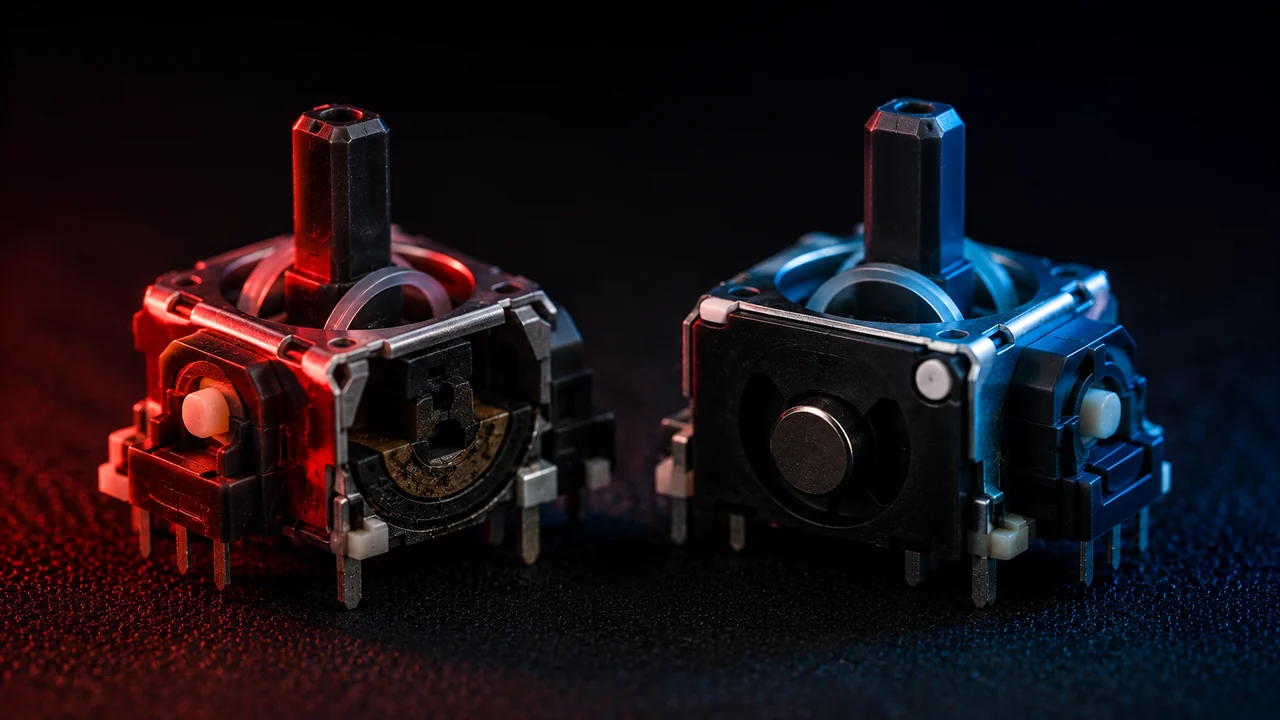
TMR and Hall effect are both non-contact magnetic sensors used in controller thumbsticks to avoid the physical wear that causes stick drift.
The short answer on TMR vs Hall effect is that both are non-contact magnetic stick sensors, so neither has the worn resistive track that makes potentiometer sticks drift. The difference is sensitivity: TDK rates its TMR sensors at 10 times the sensitivity of traditional Hall sensors [3]. Run any controller through the browser gamepad tester first, then choose between a Hall-effect pad like the 8BitDo Ultimate 2C and a pricier TMR controller.
| Property | Potentiometer | Hall effect | TMR |
|---|---|---|---|
| How it senses | Wiper on a resistive track | Magnetic field, non-contact | Magnetic field, non-contact |
| Wears out | Yes, the track abrades | No | No |
| Rated life | Alps RKJXV: 2,000,000 operating cycles [7] | No contact wear, no hour rating published | No contact wear, no hour rating published |
| Sensitivity | Not a magnetic sensor | Baseline for magnetic sticks | About 10 times Hall, per TDK [3] |
| Affected by a nearby magnet | No | Yes, if a magnet is held close to the stick | Yes, if a magnet is held close to the stick |
| Found in | DualShock 4, base DualSense, base Xbox pad, Joy-Con | 8BitDo Ultimate 2C, GuliKit KingKong | Premium 2024+ third-party pads |
| Cost to the maker | Cheapest, mature part | A few cents more than a potentiometer, per iFixit [13] | Not published |
If you only want the verdict: both magnetic types remove the worn-track cause of drift, and the choice between them is about sensor sensitivity rather than lifespan. Buy Hall effect unless you specifically want the most sensitive sensor available. Each row is expanded below, and the sensor datasheets and price sources are listed at the end.
TMR versus Hall effect, settled
- TMR vs Hall effect is a sensitivity debate, not a lifespan debate, and neither has a potentiometer’s wearing track.
- Hall-effect sticks (8BitDo Ultimate 2C, GuliKit KK3 Max) have no resistive track to wear out.
- TMR sticks sit at the premium end and use a more sensitive sensor.
- A magnet held close to the stick can offset a magnetic stick; potentiometer sticks ignore magnets entirely.
- No manufacturer publishes an idle tolerance for a stick, so there is no spec to be past. Judge a reading against the tester’s own warn threshold for your pad’s family, which is 0.08 on a DualSense, 0.10 on an Xbox pad and 0.05 on a Joy-Con.
The Allegro A1304 is a documented controller-grade Hall IC with published linearity and field-range specifications on the Allegro Microsystems product page. JoyCheck reviewed the manufacturer datasheet before publishing this guide.
Measure what you already own first
- Open JoyCheck in Chrome, Firefox, Edge, or Safari.
- Connect any controller over USB-C or Bluetooth, then press a button to wake the binding.
- Set the controller flat on a table, hands off the sticks.
- Read the rest values. A healthy stick of either type sits close to 0.00, and the flicker you see is sensor noise.
- Compare the number against the warn threshold the tester applies to your pad’s family rather than a universal figure: 0.08 on DualSense and DualShock, 0.10 on Xbox and generic pads, 0.05 on Joy-Con, 0.06 on a Switch Pro.
Why is TMR not automatically better than Hall-effect?
TMR is not automatically better than Hall-effect because the two share a lifespan and differ only in noise floor, and noise floor matters in a narrow band of play. Most buying guides treat TMR as the upgrade and Hall as the older option, which skips the parts of the comparison that matter most for a buyer. Magnetic sticks are not new in consumer controllers: GuliKit’s KingKong 2 already shipped with a patented electromagnetic stick marketed as drift-free [12], and GuliKit still sells Hall-effect models such as the KK3 Max [11] next to TMR models such as the KK3 and KK2T.
The Allegro A1304 remains one of the common controller-grade Hall ICs in those builds [1].
TMR is newer for consumer controllers, reaching gaming gear through component suppliers like TDK around 2023. TMR sensors carry a higher per-unit cost on a shorter supply chain than Hall, according to TDK’s 2023 gaming sensor announcement [3].
For a manufacturer choosing today, Hall is still the safer bill-of-materials decision. Where TMR actually wins is at the small-displacement end of the stick. A TMR sensor has a higher signal-to-noise ratio than a Hall sensor of the same size, so it resolves a 0.01 stick movement more cleanly.
That resolution matters for aim-down-sights micro-corrections. It does not matter for driving a car around a Forza track.
What do TMR and Hall-effect actually mean as sensor technologies?
Both Hall-effect and TMR are non-contact magnetic sensing technologies, sharing the same hardware idea at a high level. The stick has a small permanent magnet on its stem, and an IC underneath the pivot reads the magnetic field as the stick tilts. No wiper touches the sensing element itself in either design.
Hall-effect uses the classical Hall effect, discovered by Edwin Hall in 1879. A current-carrying conductor placed in a magnetic field develops a voltage perpendicular to both, and reading that voltage gives field strength and direction. The Allegro Microsystems product family and the TI DRV5055 are the common controller-grade Hall ICs sold in 2026 [4][6].
TMR, or tunneling magnetoresistance, uses a quantum-mechanical effect inside a thin-film junction. Two ferromagnetic layers separated by an insulator change resistance based on how their magnetization vectors line up. A tilted field rotates one layer relative to the other, and the resistance changes in step.
TDK’s TMR sensor announcement lists the consumer-electronics families used in gaming gear today, including the new MMC5983MA family aimed directly at controller OEMs [3]. The practical difference for buyers is the analog signal quality, not the underlying physics. TMR sensors produce a stronger output for the same magnetic field, and linearity is also better at small angles.
Why do potentiometer sticks still exist in 2026?
Potentiometer sticks still exist in 2026 because they are far cheaper to make than magnetic sticks, and cost wins in volume controllers. Roughly 95 percent of controllers shipping in 2026 still use potentiometer sticks, including the base DualSense, the Xbox Wireless Controller, and the Joy-Con today. The exceptions are premium controllers and certain third-party brands.
The Alps Alpine RKJXV potentiometer family ships in the millions per quarter at a fraction of the cost of a Hall or TMR module [7]. Tooling, firmware, and quality-control pipelines are decades old at every major OEM.
Switching technologies costs more than the bill-of-materials delta on its own. That is why the change has not happened.
The trade is lifespan. A potentiometer stick has a physical wiper that drags across a carbon resistive track every time you move the stick. Alps rates its RKJXV potentiometer stick for 2,000,000 operating cycles [7], and once the track wears, replacing the stick module is the durable fix.
| Stick type | Sensor IC examples | Found in | Wear path | Typical lifespan |
|---|---|---|---|---|
| Potentiometer | Alps RKJXV, RKJ family | DualShock 4, base DualSense, DualSense Edge, base Xbox Wireless Controller, Joy-Con | Wiper wears resistive track | 2,000,000 operating cycles (Alps RKJXV rating) [7] |
| Hall-effect | Allegro A1304, TI DRV5055 | 8BitDo Ultimate 2C, GuliKit KingKong, third-party DualSense modules | Non-contact magnetic | No contact wear, no hour rating published |
| TMR | TDK TMR family, MultiDimension TMR | Razer Wolverine V3 Pro 8K, premium 2024+ third-party | Non-contact magnetic, about 10 times Hall sensitivity per TDK [3] | No contact wear, no hour rating published |
Sony, Microsoft, and Nintendo have all kept potentiometer sticks in their volume controllers. That decision will age badly.
How do TMR sticks differ from Hall-effect sensors?
TMR and Hall-effect sensors both read the position of a magnet on the stick stem, but they measure the field in different ways. A Hall sensor reads the small voltage a magnetic field creates across a conductor. A TMR sensor reads a change in electrical resistance across a very thin insulating layer, and TDK rates its TMR sensors at 10 times the sensitivity of traditional Hall sensors [3].
More sensitivity does not automatically mean a different feel in your hand. What you notice also depends on the controller’s firmware, its built-in dead zone and the game’s own settings, and controller makers do not publish idle-noise figures you could compare across brands.

The W3C Gamepad API exposes stick values as floats in the range minus 1.0 to plus 1.0 [8]. JoyCheck reads that value directly and shows three decimal places, so you can see a stick’s resting value but not which sensor produced it.
How do I run the TMR vs Hall comparison in my own browser?
The fastest way to see the difference is to test multiple controllers in the same browser session, and JoyCheck does this with no install, no account, and no controller data sent anywhere. Each connected pad gets its own Gamepad slot. The whole diagnostic takes about thirty seconds per controller.
- Open the gamepad tester in Chrome, Firefox, Edge, or Safari. The Gamepad API has shipped in every major desktop browser since Chrome 35.
- Connect the first controller via USB-C or Bluetooth. DualSense and DualSense Edge use USB-C [10].
- Press any button to wake the Gamepad API binding. This is a one-time interaction guard against drive-by fingerprinting.
- Place the controller flat and let go. Wait five seconds. Read the four axis values for both sticks.
- Repeat with the next controller. Each connected controller gets its own Gamepad slot.
- Compare the rest values between the two pads on the same machine. That side-by-side is the reliable comparison, because both readings face the same browser and the same display rate.
The diagnostic is identical regardless of the underlying sensor technology, because the Gamepad API does not know what is inside the controller.
For deeper background on the wear path itself, see stick drift explained [5], and for the W3C Gamepad API binding details see how JoyCheck works.
Can an external magnet affect a TMR or Hall-effect controller?
Yes, an external magnet can affect a TMR or Hall-effect controller, because both technologies depend on a permanent magnet on the stick stem. The sensor reads the combined field whenever a second magnet sits close enough. This is the one place where potentiometer sticks have a quiet advantage over magnetic sticks in odd setups.
How close is too close depends on the magnet’s strength and on the controller’s own shielding, and controller makers do not publish a figure. If you suspect a magnet, move every magnetic object away from the controller and watch the idle readout in JoyCheck.
Potentiometer sticks ignore external magnets entirely, so they keep a small advantage next to motors or high-current power supplies. On a normal desk, treat a magnet as the last cause of drift to rule out, not the first.
The controller’s own rumble motors also sit near the stick assemblies. If a magnetic-stick controller drifts only while rumble is running, test again with rumble disabled in the game and watch the idle readout in JoyCheck.
What does each sensor type cost the manufacturer in 2026?
Controllers still ship with potentiometer sticks in 2026 mainly because they are the cheapest and most established part. The Alps RKJXV family [7] is the volume potentiometer stick in mass-market controllers, and iFixit’s assessment is that Hall-effect setups “are a few cents pricier” [13]. Neither Alps, the Hall-effect module makers nor TDK publish the per-unit prices they charge controller makers, so any exact per-pair cost quoted online is a guess.
The retail price gap is far larger than the sensor cost gap. Sony’s DualSense Edge sells for 199 USD [10] on the back of changeable stick modules, adjustable triggers and mappable back buttons, not a magnetic sensor upgrade.
For a third-party brand like 8BitDo or GuliKit, the calculation is different. They cannot match Sony or Microsoft on volume, so they compete on durability and feature density instead, with Hall-effect sticks as their volume play.
The 8BitDo Ultimate 2C ships with Hall-effect joysticks and triggers [2], and the GuliKit KK3 Max ships Hall-effect sticks and triggers [11].
When does TMR actually pay for itself?
TMR pays for itself in three specific scenarios, because durability alone does not justify the premium. A premium controller is hard to justify on lifespan alone, since a worn potentiometer stick in a base DualSense can be fixed with a stick-module replacement [9]. Several module swaps still cost less than one top-tier pad.
The first scenario is competitive FPS or fighting-game play, where players care most about the smallest stick movements, so a more sensitive sensor is the easiest upgrade to justify.
The second scenario is players who hate downtime and would rather pay once for a long-life controller than learn the iFixit DualSense stick-replacement guide [9]. An hour of careful soldering is real labour for a non-technician.
The third scenario is sim racers and flight-sim users who keep the same controller for years and put thousands of hours on it. For them, a sensor with no contact wear matters more than the price.
For everyone else, a potentiometer-stick controller plus a stick-module replacement when drift appears is the cheaper path.
Which AAA platform holders ship which stick sensors in 2026?
Sony, Microsoft, and Nintendo all keep potentiometer sticks in their controllers, and none of them ships a first-party Hall-effect or TMR pad in 2026 [10]. The big three have left magnetic sensors to third-party brands so far.
Sony Interactive Entertainment ships potentiometer sticks in both the base DualSense and the DualSense Edge [10]. The Edge premium buys replaceable stick modules and adjustable tension, not a magnetic sensor. There is no Hall-effect or TMR controller in the official Sony line.
Microsoft ships potentiometer sticks in every official Xbox Wireless Controller, including the Xbox Elite Series 2. The Elite Series 2 launched in 2019 before Hall-effect was common in consumer controllers, and Microsoft has not refreshed it with magnetic sticks since.
Nintendo ships potentiometer sticks in Joy-Con. The Joy-Con drift class-action suits in 2020 and 2021 made the issue famous, but Nintendo has not switched stick technology in the current generation.
Which third-party brands ship Hall or TMR in 2026?
Third-party brands have done most of the magnetic-sensor pioneering work, with 8BitDo and GuliKit leading on Hall-effect adoption and Razer leading on TMR in the Wolverine V3 line. The price points sit far below first-party premium tiers, which is why these brands now own the drift-free conversation.
8BitDo ships Hall-effect sticks in the Ultimate Wireless and Ultimate 2C [2]. The Pro 2 ships with potentiometer sticks plus a firmware deadzone update.
GuliKit lists Hall-effect joysticks and triggers on the KK3 Max [11] and the KK3 Pro, but not across the whole range: its KK3 and KK2T models use TMR sticks instead.
Razer, Scuf, and PowerA are mixed. Razer’s Wolverine V3 line includes a TMR variant, Scuf Reflex ships Hall, and PowerA’s pro line ships potentiometer in most SKUs.
If a controller advertises “drift-resistant sticks” without naming the sensor, that wording most likely means a tightened firmware deadzone.
Should I run my controller through JoyCheck before buying?
Yes, run the diagnostic before you spend the upgrade money on a new controller, because the answer often sits inside what you already own. If you are deciding whether to replace your pad, upgrade the sticks, or buy a premium model with TMR, thirty seconds of testing settles it. Nothing leaves your browser at any point.
Open JoyCheck and connect any controller from your shelf first.
For sibling guides on the same hardware, see which PS5 controllers ship hall-effect sticks, the DualSense calibration walkthrough, and the DualShock 4 calibration walkthrough.
For the W3C Gamepad API binding details and what the browser actually reads from the firmware, the how JoyCheck works pillar covers the polling cadence and deadzone math. To launch the tester itself, the JoyCheck home page accepts any USB or Bluetooth controller.
Sensor datasheets and pricing sources
- Allegro Microsystems · A1304 linear Hall-effect sensor IC. Manufacturer product page with published linearity and field-range specifications for a controller-grade Hall IC.
- 8BitDo · Ultimate 2C Wireless Controller. Product page for the Hall-effect controller used as the Hall reference point in this guide.
- TDK InvenSense · TMR sensors for high-performance gaming gear. 2023 press release; states TMR has 10 times the sensitivity of traditional Hall sensors and wear-free operation.
- Allegro Microsystems · Linear position sensor IC product family. Overview of the Hall-effect sensor product line referenced for controller-grade ICs.
- JoyCheck · Stick drift explained. Companion guide on the potentiometer wear path and confirming drift in a browser.
- Texas Instruments · DRV5055 linear Hall-effect sensor. Datasheet for a common controller-grade Hall IC sold in 2026.
- Alps Alpine · RKJXV multi-control switch. Product page for an RKJXV part, lists an operating life of 2,000,000 cycles.
- W3C · Gamepad API specification. The standard defining the normalized analog-stick value range that browsers expose.
- iFixit · DualSense controller repair guide. Teardown and repair guides for DualSense stick-module replacement.
- PlayStation Direct · DualSense Edge wireless controller. Official product page for Sony’s premium controller with replaceable stick modules.
- GuliKit · KK3 MAX controller. Official product page, lists Hall-effect joysticks and triggers.
- GuliKit · KingKong 2 controller. Official product page, describes the patented electromagnetic stick.
- iFixit · Can Hall Effect Sensors Stop Drift Forever?. iFixit’s explainer on Hall-effect sticks; source of the “a few cents pricier” cost comparison.
What is the difference between TMR sticks and Hall-effect sticks?
Both are non-contact magnetic sensors with a magnet on the stick stem and an IC underneath. TMR uses tunneling magnetoresistance, which TDK, a maker of TMR sensors, rates at 10 times the sensitivity of traditional Hall sensors. Neither type has a contact track to wear out, and no maker publishes a lifespan for either in hours of play.
Which is better for a PS5 controller, TMR or Hall-effect?
For a PS5, neither sensor is built in: the base DualSense and the DualSense Edge both use potentiometer sticks. To get a magnetic stick you go third-party, with licensed Hall-effect pads like the Nacon Revolution 5 Pro or a stick-module swap into a DualSense. TMR is better for competitive FPS play and Hall is better value for general use, and both beat potentiometer on lifespan by a factor of three to four.
Are TMR sticks worth the premium over Hall-effect?
For competitive FPS or fighting-game play, yes. The tighter idle noise floor and better small-displacement linearity show up in pixel-level aim and frame-perfect inputs. For racing, platforming, or general gaming, Hall-effect at half the cost is a better value pick.
Do Hall-effect or TMR sticks ever drift?
Yes, but the wear path is different from a potentiometer. Hall and TMR sticks do not wear at the sensor itself, but the rubber stick cap, the bearings, or the magnetic shielding can degrade. A drifting Hall or TMR controller is most often a magnet alignment or shielding issue, not sensor wear.
How long do potentiometer sticks last compared to Hall-effect and TMR?
Alps rates its RKJXV potentiometer stick, a part family used in mass-market controllers, for 2,000,000 operating cycles. That is a lab rating, and makers do not convert it into hours of play. Hall-effect and TMR sticks have no contact track, so the sensor itself does not wear, but the spring and gimbal around it are still mechanical parts.
Can a strong magnet affect Hall-effect or TMR controller sticks?
Yes. Both technologies read the stick's magnet field, so a strong magnet held close to the stick can cause a brief offset. How close is too close depends on the magnet and the controller's shielding, and makers do not publish a figure. Potentiometer sticks ignore external magnets entirely.
Can JoyCheck tell me whether my controller has TMR, Hall, or potentiometer sticks?
Not directly, because the W3C Gamepad API does not expose the sensor type to the browser. What JoyCheck shows is each stick's resting value and drift pattern, which tells you whether the stick is healthy, not which sensor it uses.
Test the sticks you already own
Know your current noise floor before paying for a new one.